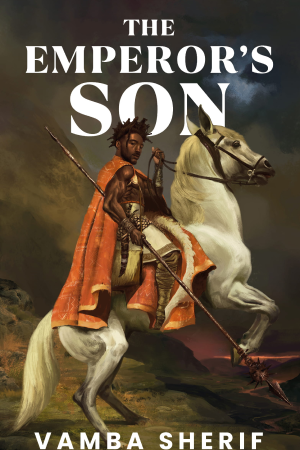
The Emperor’s Son
You are the tree that you brought with you, Zaiwulo. So plant it here, for it belongs to this place now, to the earth of this land far away from home.
available
Get the book
Look inside
×1
There was nothing remarkable about Zaiwulo to suggest the kind of man he would become. The boy, who would turn thirteen that year, was carrying a tree sapling with him when he arrived Musadu in Koniyan. He was wearing a short tunic and amulets around his neck and biceps. His hair was closely cropped, and at his tender age, he walked with a stoop.
Though the dry season had ended, a wave of heat swept over him as he made his way down the hill to catch up with his father who was walking ahead and had almost reached the river. The land around Zaiwulo was a lush green and yellow grass dotted with anthills and tree stumps. The verdant grass was bare of the trees and huge mountains of the land of his birth. From where he was on the hill, he could see Musadu beyond the river, shielded by walls unlike any he had ever seen before.
The earthy, sharp smell of the savannah filled his nose, and as he watched from the hilltop, a horse appeared in the distance, then came the sound of jangling bells alongside hoofbeats. The animal looked to be without a rider, but as it bore down on Zaiwulo, closer and closer, as if intent on running him over, the boy noticed a man astride the horse. Except for a few tufts of hair, the rider was bald and rode barefoot on the steed which was adorned with bells.
The horseman spurred his ride toward Zaiwulo, and the horse, teeth bared, snatched the tree sapling from the youth who screamed so loud that the animal let go of the sapling and reared back in agitation. The rider tugged sharply at the reigns and strained to calm the horse.
Zaiwulo picked up his treasure and hugged it tightly to his chest, as though it were a living being. It was a flame tree sapling yet to blossom into full orange-red leaves.
The rider looked down at Zaiwulo, surprised at the boy’s courage, for he was a man used to people fleeing at the mere sight of him.
“What does the tree mean to you, child?” he asked in Mandé.
The language was a variation of Kpelle, Zaiwulo’s native language. For reasons unknown to him, his father had insisted that he learn to speak Mandé since childhood.
By then, Zaiwulo’s father had run back to join them. He angrily shoved his son aside and faced the horseman with a broad smile.
“We are not from this part of the world,” he said in a quavering voice. “We are from the forest. And my son —”
“My mother was one of your people,” the horseman said, his eyes still fixed on Zaiwulo, as if appraising him. After a few moments, as though it were an afterthought, the horseman added: “For many years now, I’ve been fighting in Samori’s army.”
On hearing Samori’s name, Zaiwulo’s father threw himself before the horse and rider. Zaiwulo had never seen his father prostrate before any man, not even a king. To conceal his confusion and his inability to explain the gesture, he did the same.
The horse nuzzled against Zaiwulo’s neck; its tongue moved across his skin in a sustained caress that made the horseman laugh.
“You are a peculiar child,” he said, and with a click of his tongue, he prodded his ride down the road, toward the river and was gone.
Father and son did not move, not even after the sound of hoofbeats faded in the distance. They only rose to their feet when they were sure they were alone. As though imparting a terrible secret to his son, the father said, “that one is a sofa—a horse father. They are warriors who regard their horses as human beings and consider themselves their guardians. Beware of them.”
End of sample. From The Emperor’s Son.
Bulk, trade & institutional orders
About the book
A historical novel set in late nineteenth-century West Africa, during the expansion and destruction of Samori Touré’s empire and the consolidation of French and British colonial rule. It follows Zaiwulo, a boy from the forest village of Haindi sent to study in the walled city of Musadu and then drawn into Samori’s marching courts and battlefields.
Through intimate family conflicts, debates among scholars and rulers, battle scenes, and the recurring symbol of the flame tree that Zaiwulo plants and returns to over decades, the novel shows how African families, scholars, warriors, and traders experienced empire-building and colonisation from within. It explores the ways law and religion could be used both to protect and to terrorise, and how individuals tried to hold on to knowledge, dignity, and community amid upheaval.
Book details
Contributors
Author in focus
Praise & recognition
A captivating narrative about tumultuous wars and doomed alliances that is as rich in fervour as it is imaginative in reconstructing the adventurous life and times of the fabled Mande emperor, Samori Touré.
Momoh Sekou Dudu, author of Harrowing December
Lush, immediate and brilliantly conceived. Vamba’s prose challenges both writers and readers of world literature to be more thoughtful, more generous, more true to themselves.
Wayétu Moore, author of She Would Be King
Related reading
Chosen by contributor, series, and subject — not an automated “others also bought” list.