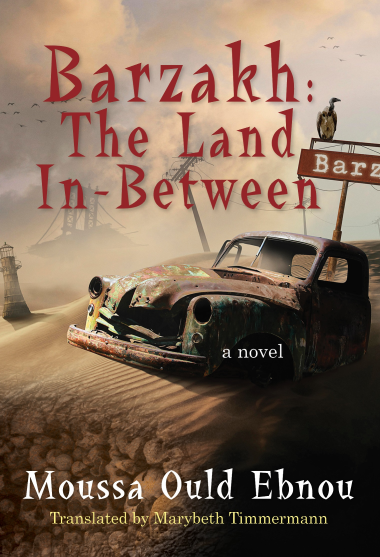
Barzakh: The Land In-Between
How did this universe, which has witnessed the birth of so many creatures, lose everything to preserve only these few men and their animals?
available
Get the book
Look inside
×The Salt Caravan
I remember that tragic night—I tossed and turned on my damp straw bed for hours, chasing an elusive night’s sleep. I was tense, drenched in sweat, besieged by mosquitoes and macabre premonitions—terrible, nameless worries. Outside, it was oppressive. The heat had immobilized and solidified the air. I could still hear the muffled beating of distant drums that, for two days now, had been echoing endlessly across the entire savanna to announce the salt caravan. It was as if they were beating inside my head, which was on the verge of exploding. I could imagine the camel drivers entering into the enclosure reserved for the caravan, leading their animals—exhausted from the long and difficult journey—by the nose, and the slaves perched on the camels’ backs, tirelessly beating the enormous drums securely wedged between the double loads. The caravan travelers would have their camels kneel while they unloaded their packsaddles, shouting to one another. The animals would be grunting and thrashing about in pain; the heavy loads they carried had bruised and scraped and dug into their backs for so long that necrosis had set in. The slabs of salt would be untied from the saddletrees, transported far from the fence and arranged in stacks, according to which merchant owned them. Once the camels were freed from their packsaddles, they would be led out of the enclosure and hobbled tightly to prevent them from wandering off. These desert men and beasts would be intoxicated by the strong smells of the luxurious vegetation of the African savanna and stunned by the oppressive heat so laden with humidity.
Dispassionate sleep had finally deigned to visit me when I felt a hand shake me vigorously and heard the voice of my father close to me.
“Gara! Gara! Wake up; get up, my son. We’re going to the salt caravan. Hurry, hurry, before all the salt is sold!”
I squinted my eyes open—it was still dark out. I could hardly make out the silhouette of my father who was still shaking me. I got out of bed, rubbing my eyes, wobbly and half-asleep. My father put a rough calabash into my hands.
“Here, drink this. The day will be hot.”
I lifted it to my mouth, gulping down the bitter mixture of water and curdled milk.
We left the village before dawn, passing the millet fields located to the west. I thought I was accompanying my father to comfort him during the trip. However, I was intrigued. In previous years, he went to the salt market with gold and slaves; now that he no longer had any slaves, he should have at least brought some gold.
“Father, how are we going to pay for the salt?”
“You’ll see, it’ll be easy! You merely have to ask one of the merchants to lend us some until the next caravan— I’ll reimburse him with double the gold and double the slaves!”
The sun found us in a vast, marshy plain rich in aquatic plants and acacia trees whose sturdy branches supported thin, flexible stems that, after reaching their summit, fell back down in a tangle of richly flowering garlands. Often, they wound themselves around other nearby plants, becoming a tight unit with them through the interlacing, sinuous folds of their many branches, and forming a celestial vault through which other, still more beautiful compositions delighted the eyes.
End of sample. From Barzakh: The Land In-Between.
Bulk, trade & institutional orders
About the book
A speculative literary novel set across centuries in the Sahara, following Gara, a young man sold into a salt caravan, and Vala, the enslaved woman he loves. He is trafficked along trans-Saharan routes, drawn into a planned rebellion, and later caught in waves of colonial and postcolonial violence — while in the far future, scientists decode fragments of his consciousness.
Through slavery, rebellion, colonial violence, ecological collapse, and a future archaeological expedition, the book asks what remains of a human life — and of a civilisation — after death, memory, and time have done their work. Blending historical realism with metaphysical fiction, told through first-person testimony “decoded” from myelin crystals, it examines suffering, freedom, faith, and the fate of the desert itself.
Book details
Contributors
Author in focus
Praise & recognition
Presented as a transcript of the stream of consciousness translated from the remains of a skeleton found at the top of a mountain in Ghallawiya… an ambitious premise for an ultimately dystopian vision.
Regina Schroeder, Booklist
The landscape of Barzakh is ethereal and alien. I left the book feeling unsure, but also satisfied — curious about what I had been missing, ready to go searching through a new world.
Jason Kahler, The Future Fire
Related reading
Chosen by contributor, series, and subject — not an automated “others also bought” list.